


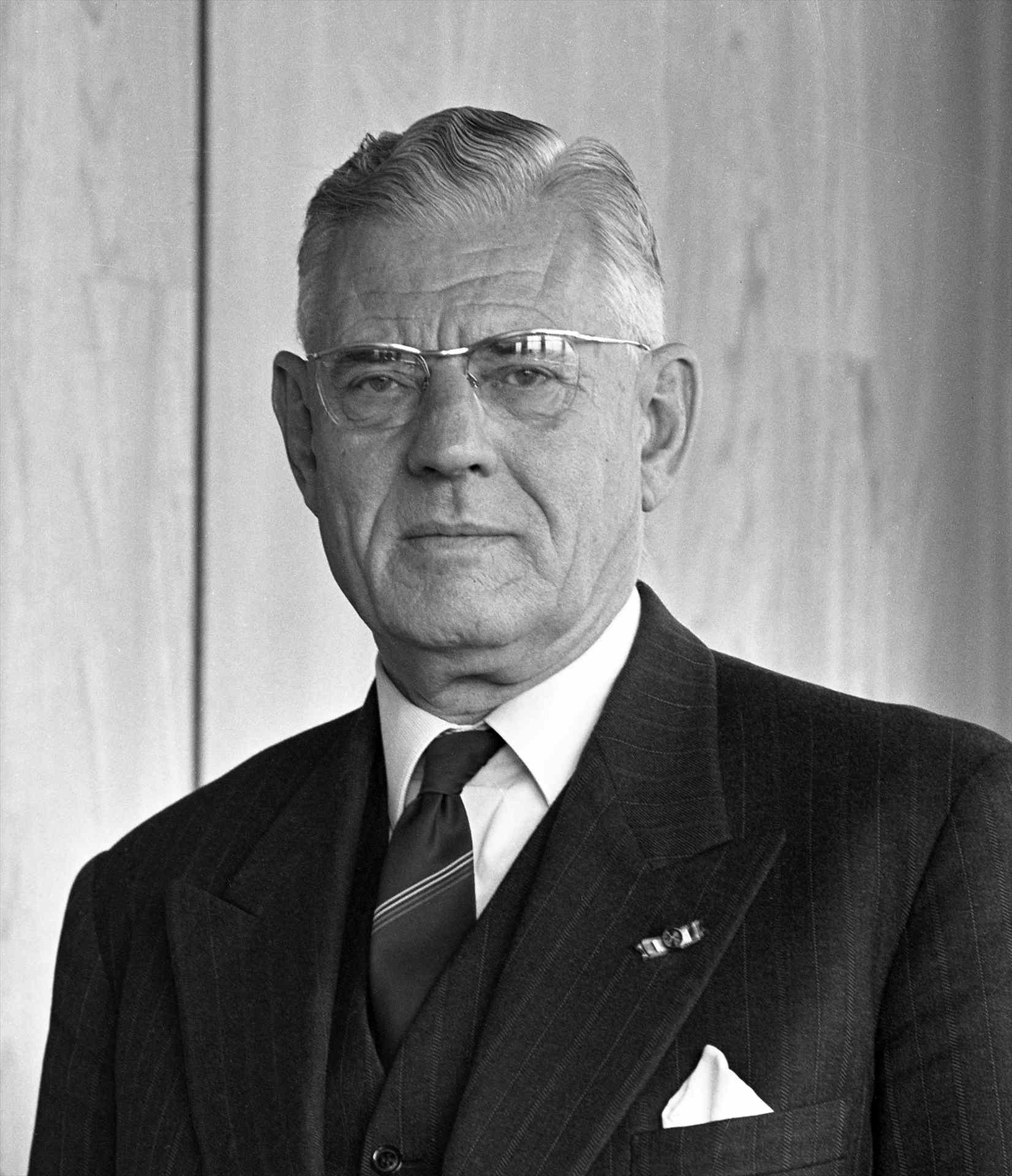
Dr. Ir. Th. P. Theo Tromp (1903-1984)

The idea that became TROMP
Dr. Ir. Th. P. Tromp - The Man Behind TROMP
The story of TROMP begins with a simple question: what could I give back to Eindhoven?
For Dr. Ir. Th. P. Tromp, Eindhoven was a city where he had built his professional career for more than forty years and to which he felt a deep personal connection. He started working at Philips in 1927 and, from 1946, was a member of the company’s Board of Management, serving as Vice President from 1957 until his retirement in 1967. Shortly after his retirement, he began thinking about a meaningful gift to the city.
Tromp was a sportsman at heart. His first thought was therefore to do something for sport. But, as he himself put it, so much was already being done in that field. A playground did not appeal to him either. Instead, he turned to another passion: the arts, and particularly music.
His idea was to create a competition that would give young, talented musicians something they often lacked: an opportunity to be heard.
“I believe it is particularly good that young, talented musicians are given the opportunity through this competition to perform in public.”
Tromp was especially concerned with young musicians who wanted to build a career as soloists. He believed that such musicians could have a difficult path ahead of them, and that a competition could provide not only recognition, but also an important step into professional life.
His vision also included a broader ambition for Eindhoven. He also recognised the broader importance of a strong cultural environment for Eindhoven. By creating a cultural platform that could enrich the social and cultural life of the city and its surroundings, he hoped to make Eindhoven a more attractive place for the high-tech talent that Philips, then undergoing rapid development, increasingly needed.
A competition with a purpose
For Tromp, the competition was about more than simply winning a prize. He saw TROMP as a way of discovering and drawing attention to exceptional young musicians — what the 1971 Philips Koerier described as a form of “talent scouting” for orchestral directors.
He therefore took considerable care before deciding how his gift should be used. He spoke with people who understood the musical world and, in particular, with Hein Jordans, conductor of the Brabant Orchestra. Jordans' enthusiasm convinced Tromp that a competition for young musicians could be of real importance.
Tromp ultimately made 150,000 guilders available to the municipality of Eindhoven to make the initiative possible.
A Benelux vision
The competition was not intended to be confined to the Netherlands. Tromp had long supported the idea of the Benelux as a community. He saw Eindhoven as a place that could connect the Netherlands and Belgium culturally, and believed the city could become an important cultural centre for the Kempen region.
For that reason, the competition was conceived from the beginning for young professional musicians from the Benelux countries, rather than Dutch musicians alone.
His choice reflected something fundamental about Tromp's outlook: he wanted the initiative to belong to Eindhoven, but he did not want its horizons to stop at the city or national border.
Giving the idea its own life
Perhaps one of the most revealing aspects of Tromp's role is what he chose not to do.
Although he provided the financial foundation for the competition, he did not want to control it. Once the TROMP foundation had been established, he deliberately stepped away from its organization.
“It would not be right for me to interfere with the organization.”
He believed that the foundation board and its secretariat had the expertise to make the artistic and organizational decisions themselves and should be able to operate autonomously.
This principle became part of the character of TROMP: Tromp provided the opportunity, but he entrusted others with its development.
Music was also part of his own life
His interest in music was not abstract. Tromp came from a musical family. An uncle to whom he was particularly attached had spent virtually his entire life as a violinist. His father and paternal grandfather were both accomplished pianists, and Tromp remembered music being performed at home every week by a quartet.
It was therefore especially meaningful to him that the violin was chosen for the first edition of the competition in 1971.
Tromp himself had once played the piano, although modestly by his own account. As a student in Delft, he gave it up because he felt that his father's playing was so good that he could never match it. He later admitted that he sometimes regretted that decision. Music remained part of his life, however, and he compensated by listening to good music whenever his limited free time allowed.
A name he did not ask for
There is also a revealing modesty in the name Tromp.
Tromp himself had not asked for the competition to bear his name. In fact, he said that the idea came from the foundation board, which asked whether he objected. He did not — although he had personally imagined a different name: the Benelux Music Competition.
That detail says something about his original intention. The competition was never conceived as a monument to himself. His aim was to create something useful: an opportunity for young musicians, a cultural meeting point for the Benelux, and a lasting contribution to the city with which he had been associated for so much of his life.
The first Tromp Music Competition took place in Eindhoven in September 1971, with fifteen young professional musicians from the Benelux countries taking part.
What began with Tromp's question — what could I give back to Eindhoven? — became a competition designed to give something to others: a stage, an opportunity, recognition, and a possible beginning to a career.
That idea remains at the heart of TROMP.

More about Dr. Ir. Th. P. Tromp
Verzetsman en ereburger van Eindhoven (in Dutch)
Artikel Philips Koerier, 7 juni 1984 - Dr Ir Th P Tromp overleden - In memoriam
with many thanks to Koninklijke Philips N.V. / Philips Company Archives

TROMP today
From Music Competition to Percussion Festival - How a competition for young musicians grew into an international platform for percussion
When the first Tromp Music Competition took place in Eindhoven in September 1971, nobody could have known exactly what it would become.
The idea of founder Dr. ir. Theo Tromp was clear: every two years, young professional musicians should be given the opportunity to perform at a high level, to be discovered, and to take an important step towards a professional career. The competition was initially conceived for musicians from the Benelux, with a different solo instrument at the centre of each edition.
That original idea would prove remarkably adaptable.
Over the following decades, TROMP changed instruments, expanded its geographical reach, introduced new artistic formats and gradually developed from a specialist competition into an international festival. What remained constant was the belief at the heart of Tromp's original vision: give exceptional young musicians a stage, and give their talent the opportunity to grow.
A competition that changed its instrument
The first edition in 1971 focused on the violin. The winner was the young Dutch violinist Emmy Verhey, who went on to build a major career.
The choice of instrument was not fixed. Tromp had envisioned a competition in which a different solo instrument would take centre stage each time. Over the years, TROMP therefore welcomed musicians from a wide range of disciplines.
Violinists, pianists, oboists, clarinettists and other instrumentalists competed for the TROMP prize. Among the laureates were musicians such as pianist Bart van de Roer, oboist Pauline Oostenrijk and, later, ensembles and percussionists.
This changing format gave the competition a distinctive character. TROMP was not tied to one instrument or one musical tradition. Every edition created a new artistic world around the instrument in focus.
From Eindhoven to the international stage
The original competition was already international in its ambition. Tromp had deliberately chosen the Benelux as its geographical starting point, reflecting his longstanding belief in cultural exchange between the Netherlands, Belgium and Luxembourg.
But the competition gradually grew beyond that original framework.
In 2002, TROMP was opened to participants from outside the Benelux. This marked an important step in the development of the competition: what had begun as a Benelux competition became increasingly international.
The change also reflected the growing reputation of the competition. TROMP was no longer simply an opportunity for young musicians from neighbouring countries. It was becoming a place where ambitious musicians from around the world could meet, compete and establish themselves.
A new chapter: percussion
One of the most important turning points came when TROMP began to focus increasingly on percussion.
In the early 2000s, percussion was already becoming an important part of the TROMP story. The 2000 competition, for example, was won by Australian percussionist Claire Edwardes, while later editions brought percussionists such as Yi-Ping Yang and Alexej Gerassimez to the fore.
The competition's direction changed decisively around 2010, when the organization chose to continue as an international percussion competition. By 2012, the competition had become exclusively focused on percussion.
This was not simply a change of instrument. It was the beginning of a new identity.
Percussion offered an enormous artistic world: classical instruments, contemporary music, electronics, theatrical performance, new compositions and traditions from around the globe. It was a field in which young musicians were not only developing exceptional technical skills, but also redefining what a solo musician could be.
TROMP became a place where that development could happen.
More than a competition
Another important development was the growth of the festival around the competition.
In 2004, a festival element was introduced alongside the competition. This marked the beginning of a broader idea: TROMP could be more than a contest in which musicians competed for prizes. It could become a meeting place for artists, audiences and the wider musical community.
Concerts, performances, educational activities and masterclasses gradually became part of the TROMP experience.
The competition remained at the centre, but it was increasingly surrounded by opportunities to listen, learn and experiment.
Today, TROMP describes itself through three connected pillars: Competition, Festival and Education. The organization invests in young musicians not only through the competition itself, but also through masterclasses, study opportunities, educational programmes, performances and international activities.
A competition that launches careers
Perhaps the most important measure of TROMP's evolution is what happened to its laureates.
The list of winners and prizewinners reads like a record of musicians who went on to establish significant international careers. Emmy Verhey won the first competition in 1971. Bart van de Roer won in 1996. Claire Edwardes won the percussion competition in 2000, followed by Yi-Ping Yang in 2006, Alexej Gerassimez in 2010, Alexandre Esperet in 2012, Dominique Vleeshouwers in 2014, and Emil Kuyumcuyan in 2016. More recent laureates have continued that international trajectory.
The careers of these musicians demonstrate the continuing relevance of Tromp's original idea.
A competition can offer much more than a prize. It can provide a first international audience, contact with established musicians, critical attention, professional connections and, perhaps most importantly, confidence at a crucial moment in a young artist's development.
That was precisely the opportunity Theo Tromp had hoped to create.
From competition to community
As TROMP developed, the relationship between the competition and its participants also changed.
The goal was no longer simply to identify a winner. TROMP increasingly became a place where young musicians could meet one another, work with established artists and encounter new ideas.
This is particularly significant in percussion, a discipline that crosses musical and cultural boundaries. The instrument itself can be found everywhere: in classical music, contemporary composition, world music, popular culture and experimental performance.
That diversity has helped shape the character of the modern TROMP festival.
The competition is still a serious international contest, but it exists within a much larger artistic environment.
TROMP today
Today, TROMP Percussion Eindhoven is an international competition and festival centred on solo percussion. Its programme extends beyond the competition to concerts, educational activities, masterclasses and artistic projects. The organization's current mission describes percussion as a universal language capable of connecting cultures and generations.
That is a considerable evolution from the first competition in 1971.
The first TROMP was a relatively focused competition for young professional musicians from the Benelux, with fifteen participants and the violin at its centre. Today, TROMP attracts musicians from around the world and has developed into a broad platform for percussion, bringing together competition, performance, education and artistic experimentation.
Yet there is a direct line between the two.
Theo Tromp wanted to give young musicians an opportunity to be heard.
More than fifty years later, that remains the fundamental purpose.
The instrument has changed. The geographical reach has changed. The scale has changed. The competition has become a festival, and the festival has become an international meeting place.
But the original idea has survived:
give young talent a stage, create opportunities for the future, and let music connect people.
More about TROMP
Philips Topics, 7 jan 1971 - Dr Tromp musical contest foundation set up
Artikel Philips Koerier, 10 sep 1971 - Eerste Tromp-muziekconcours (in Dutch)
Artikel Philips Koerier, 17 sep 1971 - Tromp muziekconcours is gedeeltelijk openbaar (in Dutch)
Artikel Philips Koerier, 4 okt 1973 - Terugblik op tweede Tromp-concours (in Dutch)
Artikel Philips Koerier, 8 okt 1992 - Elfde Tromp-concours - eerste Tromp Muziek Biënnale (in Dutch)
Artikel Philips Koerier, 22 sep 1994 - Saxofoon centraal in Tromp Biënnale (in Dutch)
Philips Magazine sep 2000 - Tromp Biënnale - slagwerk (in Dutch)
with many thanks to Koninklijke Philips N.V. / Philips Company Archives